Parke Soldiers
Before discussion about military ancestors, it will be illuminating to consider the question of officer commissions:
From Wikipedia: “The purchase of officer commissions in the British Army was a common practice through most of its history. The practice started in 1683 during the reign of Charles II (29 May 1630 – 6 February 1685)and continued until abolished on 1 November 1871, as part of the Cardwell Reforms.
Commissions could only be purchased in cavalry and infantry (and, therefore, up to the rank of Colonel only). Commissions in the Royal Engineers and the Royal Artillery were awarded to those who graduated from a course at the Royal Military Academy at Woolwich, and subsequent promotion was by seniority. Such officers (and those of the Army of the British East India Company), were often looked down upon as being “not quite gentlemen” by officers who had purchased their commissions. Nor did the Royal Navy ever practise the sale of commissions, with advancement in officer ranks being solely by merit (at least in theory).
There were several key reasons behind the sale of commissions:
- It preserved the social exclusivity of the officer class.
- It served as a form of collateral against abuse of authority or gross negligence or incompetence. Disgraced officers could be cashiered by the crown (that is, stripped of their commission without reimbursement).
- It ensured that the officer class was largely populated by persons having a vested interest in maintaining the status quo, thereby reducing the possibility of Army units taking part in a revolution or coup.
- It ensured that officers had private means and were unlikely to engage in looting or pillaging, or to cheat the soldiers under their command by engaging in profiteering using army supplies.
- It provided honourably retired officers with an immediate source of capital.
The official values of commissions varied by regiment, usually in line with the differing levels of social prestige of different regiments.
In 1837 for example:
| Rank | Life Guards | Cavalry | Foot Guards | Infantry | Half-pay difference |
| Coronet/Ensign | £1,260 | £840 | £1,200 | £450 | £150 |
| Lieutenant | £1,785 | £1,190 | £2,050 | £700 | £365 |
| Captain | £3,500 | £3,225 | £4,800 | £1,800 | £511 |
| Major | £5,350 | £4,575 | £8,300 | £3,200 | £949 |
| Lieutenant Colonel | £7,250 | £6,175 | £9,000 | £4,500 | £1,314 |
*One pound in 1837 would be equivalent to US$290 in 2010 based on conversion through contemporary gold value. A farm labourer in 1800 would have earned around £30 to £40 a year.
These prices were not incremental. To purchase a promotion, an officer only had to pay the difference in price between his existing rank and the desired rank.”
We can surmise that any officer before 1681 did not purchase their commissions. There are many military men to be found amongst the descendants of the earliest Sligo family:
Sligo Regiment of militia or 22nd
It was formed on or around 25th April 1793 [under Col. Henry King]. This regiment appears to have been disbanded in 1802 [?] and reconstituted on 15th March 1803 under Major Roger Parke’s supervision. Again returning to the command of Col. Henry King. It is clear from the records that the Sligo Militia was broadly based among the Private Soldiery, with the Officers mainly being Landowners, leaseholder and Ulster Scots. The Militia records continue up to 1834 and include pay lists and Adjutants Monthly Rolls of use to genealogists. Other account records exist for later dates up to 1876.
They existed only in cadre form until embodied for emergencies like the Napoleonic wars. The numbering scheme of Militia changed frequently, but the numbers were never to be used without the county title: Sligo Militia became 124th Foot in 1833 and converted to artillery (RA) in 1877 and never affiliated with a regular infantry regiment. The Sligo Militia had a continuous existence from 1793 to 1909 when they disbanded
Sligo Militia 1793
1 Rt. Hon. Henry King Colonel
\n1 Joshua Edward Cooper Lieut. Colonel
\n1 Roger Parke Major
\n1 John Knox Captain
\n2 Thomas Jones Captain
\n3 Thomas Ormsby Captain
\n4 Robert Jones Capt. Lieuts.
\n5 Daniel Bliss Captain by Brevl
\n1 Samuel Kirkwood Lieutenant
\n2 William Ormsby Lieutenant
\n3 William Ferrall Lieutenant
\n4 Walter Tyler Lieutenant
\n5 Robert Ormsby Lieutenant
\n1 Abraham Martin Ensign
\n2 Charles Martin Ensign
\n3 Jerimiah Furey Ensign
\n4 John Hillas Ensign
\n5 Robert Farrens Ensign
\n1 John King Chaplain
\n1 Daniel Bliss Adjutant
\n1 Roger Parke [Junior] Qtr. Master
Major Parke’s Company
1 Roger Parke Major
\n1 Thomas Parke Ensign – Absent with leave
\n4 William Parke Corporal
\n7 Henry Parke Private
Officers of the Sligo Regiment:
20 Jul 1803 Lieut. Col. R Parke
31 May 1835 Lieut. J Parke
18 Jun 1874 Sub-Lieut. A Parke
Commissioned Soldiers
17th Century – Roger Parke (Major?) and his son Robert Parke (Captain):
Roger Parke (Major?)
In 1603, Sir James Fullerton, a Scottish courtier and close confidant of King James I was granted Sligo Castle but preferred to live at court in England, rather than the “Irish Wilderness”. He relinquished his interest in the post to Sir Roger Jones, who was a military veteran. It is probable that Roger Parke, who married the sister of Sir Roger Jones, was also a military veteran. Thomas Heazle Parke’s brother Benjamin wrote to the former in the 1870’s
“I then went to the Record Office where, fortunately, I know a fellow and we went through the very book that could probably refer to the family and found no Parke prior to 1627. However, I was not satisfied and spent 3 or 4 hours amongst “O’Haras” “Wood Martins” and “O’Rourkes” and I find the oldest in O’Rourkes which, before, I did not observe and that is O’Rourke in speaking of ‘Major Parke’ (evidently the first Parke and brother-in-law of Sir Roger Jones) says that his son, Captain Robert Parke lived at Newtown Castle in 1609 so it would look as if his father, Roger, must have come over in the 15th Century (he means 16th century) when you find the son in possession”.
Roger probably served in a force garrisoned in Sligo following the Nine Years’ War.
Captain Robert Parke
Captain Robert, son of Roger Parke, above, was in Sir Charles Coote’s (became the Earl of Montrath) regiment of foot.
William Parks
Ensign and adjutant in col. Price’s regt. (Vicar’s index to prerogative wills of Ireland 1536 – 1810)
18th Century:
Lt. John Parke
Of Castlegal and Drumcliffe, son of William Parke (Pasheendarragh & Doonally), was a brother of Roger (married Isabella Ormsby) and Robert (married Jean de la Fausille). It is not known how he came to use the title ‘Lieutenant”.
Captain Edward Parke
Born about 1694 and died between 1734 and 1740, was a cousin of the William Parke who married Jane Nesbitt. Nothing is known about his military background.
Lieutenant William Parke
Born about 1700 and supposed to have died 1758 in Portugal, was a brother of Captain Edward. Nothing is known about his military connection.
Lt.-Col. Roger Parke
Born 1722 and died 1819, was a son of William Parke (who married Jane Nesbitt) and brother to Major Andrew Parke and another soldier brother John Parke (about whom little is known). He was a Lieutenant-Colonel in the Sligo Militia. In the nominal roll of officers of the County Sligo Regiment for the year 1793, showing the rank last held by each, he appears as “R. Parke, commissioned 20 July 1807 in the rank of Lieutenant Colonel”. This is confirmed by the entry “Lt Col Roger Parke, 20/7/1807” appearing in a list of officers of the Sligo Militia or 22nd Battalion published in the Gentleman’s Almanac.
John Parke
Brother to Lt.-Col. Roger and Major Andrew, nothing is known about his service, except that his nephew, Sir William Parke, said that John was in the army.
Major Andrew Parke (brother of Lt.-Col. Roger)
Of the 8th (The King’s) Regiment of Foot was a notable figure who bridged the Sligo family tree directly into the American Revolutionary War. He was on the British side in the American War of Independence (American Revolutionary War (1775-83)) : Also Invasion of Canada.
British Officers serving in the American Revolution:
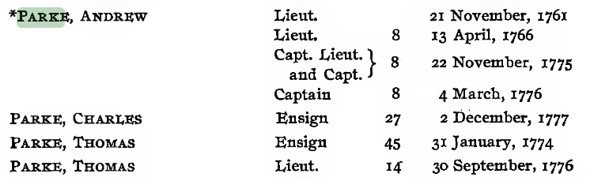
American Soldiers’ Lives: The revolutionary War, Charles P. Neimeyer 1954
“At 2:00 A.M. on May 27, Major Sherbourne and Captain Andrew Parke (Captain Forster’s second in command) suddenly appeared out of the darkness and presented to Arnold their captors’ terms that once again reiterated the threat of unleashing the Indians on the prisoners of war (POW) and included a clause that offered a prisoner exchange of an equal number of British troops in American hands.”
(Lieutenant, became Captain 26 March 1776 in 8th Regiment of Foot Soldiers).
The Scots Magazine vol. xxxviii p 166
Preferments: War Office March 26, 1776: 8th regiment of foot: Capt.- Lieut. Andrew Parke
1. Active Service in the American Revolution (1776–1781)
Andrew Parke bought or was awarded his Captaincy on 26 March 1776 right as the American colonies erupted into full revolt. Because the 8th Foot was garrisoned in Canada and the Great Lakes frontier, he was pushed into the deep wilderness theater of the war:
• The Battle of the Cedars (May 1776): Freshly promoted, Captain Parke served under Captain George Forster during the siege and capture of an American Continental Army outpost in Quebec. He was personally responsible for guarding the captured American prisoners of war.
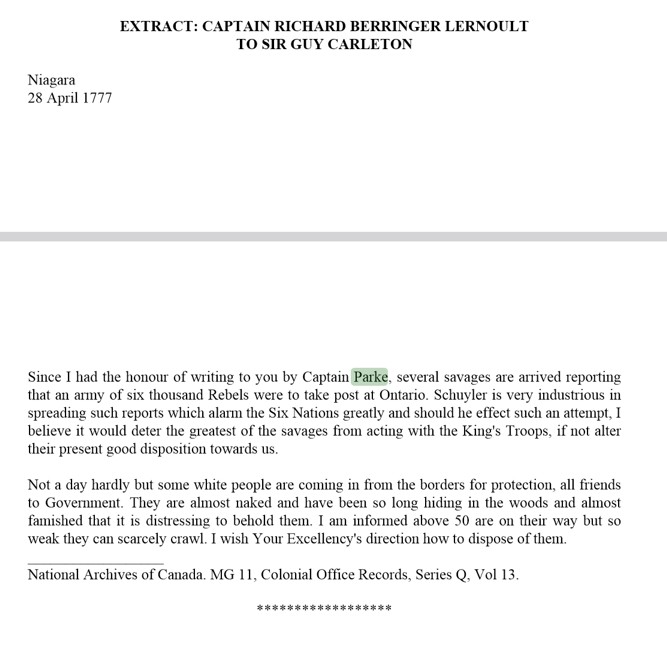
• Fort Detroit Treason Trials (1779): By 1779, Parke was stationed deep in the interior frontier at Fort Detroit. Alongside Captain Lernoult, he sat as a military judge on trials prosecuting local frontier farmers accused of treason and spying for George Washington’s rebels.
• The Niagara Land Deed Treaty (1781): On 9 May 1781, representing the British Crown’s military authority, Captain Andrew Parke explicitly signed a historic land deed treaty with the Chiefs of the Mississauga and Chippewa (Ojibway) Nations. This treaty purchased a four-mile-wide strip of land along the Niagara River, helping to establish the early borders of what is now Ontario, Canada.
• The Battle of Klock’s Field (1780): He led elite light elements of the 8th Foot during the brutal Mohawk Valley raids in New York under Sir John Johnson.
2. Later Rank and Return to Sligo
Following his grueling frontier campaigns, Andrew Parke eventually achieved the rank of Major in the 8th Foot. He returned to County Sligo, Ireland, where he integrated back into the local landed elite, serving in the local Sligo Yeomanry Cavalry later in the 1790s. He passed away on 3 September 1803 and was laid to rest alongside his ancestors in Drumcliff Cemetery, Sligo.
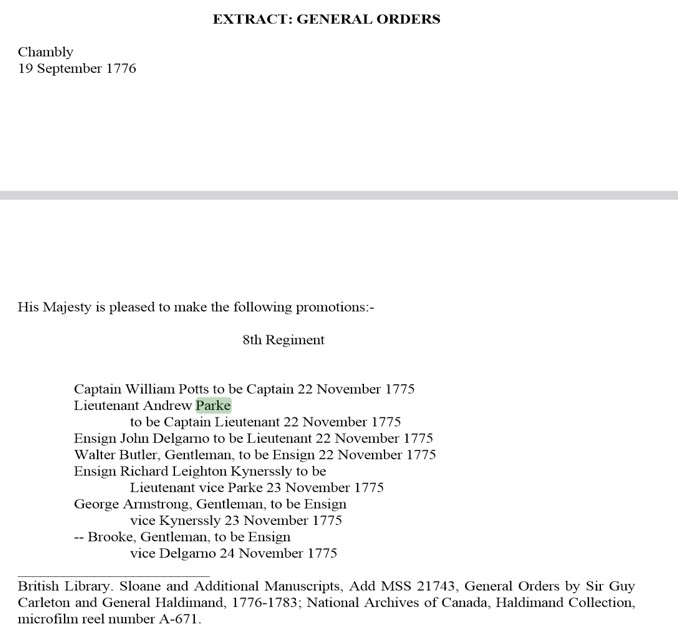
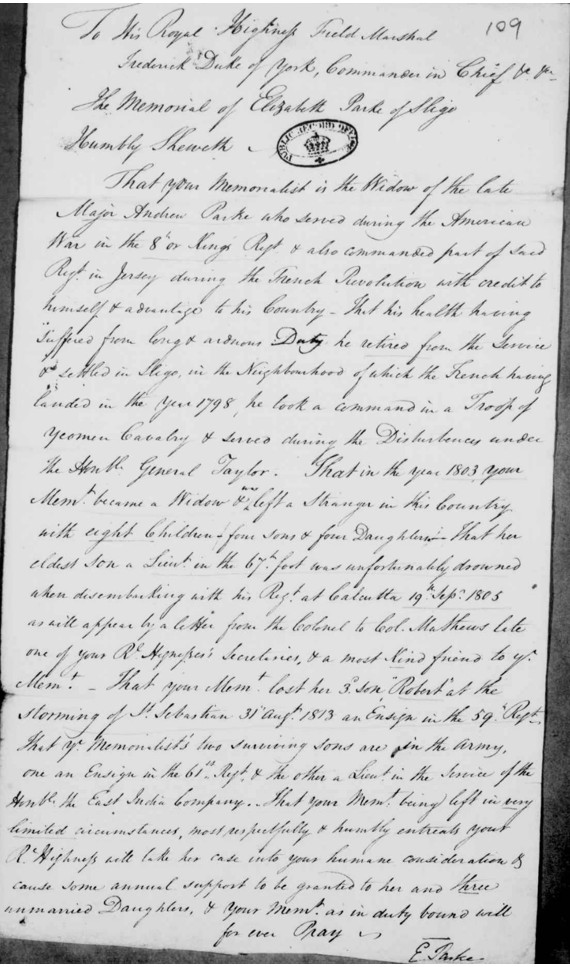
Captain Andrew had four sons (all of whom served in the army) and 4 daughters. After his death, his widow petitioned the Duke of York (commander in chief) for a pension to help support her and three unmarried daughters:
From: War Office Series 42
To His Royal Highness Field Marshal Federick Duke of York, Commander in Chief
The Memorial of Elizabeth Parke of Sligo
Humbly Sheweth
That your memorialist is the Widow of the late Major Andrew Parke who served during the American War in the 8th or Kings Regt. & also commanded part of said Regt. in Jersey during the French Revolution with credit to himself & advantage to his Country. That his health having suffered from long and arduous Duty he retired from the Service & settled in Sligo, in the neighbourhood of which the French having landed in the year 1798, he took a command in a troop of Yeoman Cavalry & served during the Disturbances under the Honle. General Taylor. That in the year 1803 your Memorialist became a Widow & was left a Stranger in this Country with eight children – four sons and four daughters. That her eldest son a Lieut. in the 67th foot was unfortunately drowned when disembarking with his Regt. at Calcutta 19th Sept. 1805 as will appear by a letter from the Colonel to Col. Matthews late one of your Rl. Highness’ Secretaries & a most Kind friend to yr. Memt. – That yr. Memt. lost her 3rd son Robert at the storming of St Sebastian 31st August 1813, an Ensign with the 59th Regt. That yr. Memorialist’s two remaining sons are in the army, one an Ensign in the 61st Regt. & the other a Lieutenant in the service of the Honle. the East India Company. That your Memt. being left in very limited circumstances, most respectfully & humbly entreats Rl. Highness will take her case into your humane consideration & cause some annual support to be granted to her and three unmarried Daughters, & your Memt. as in duty bound will for ever Pray.
E Parke
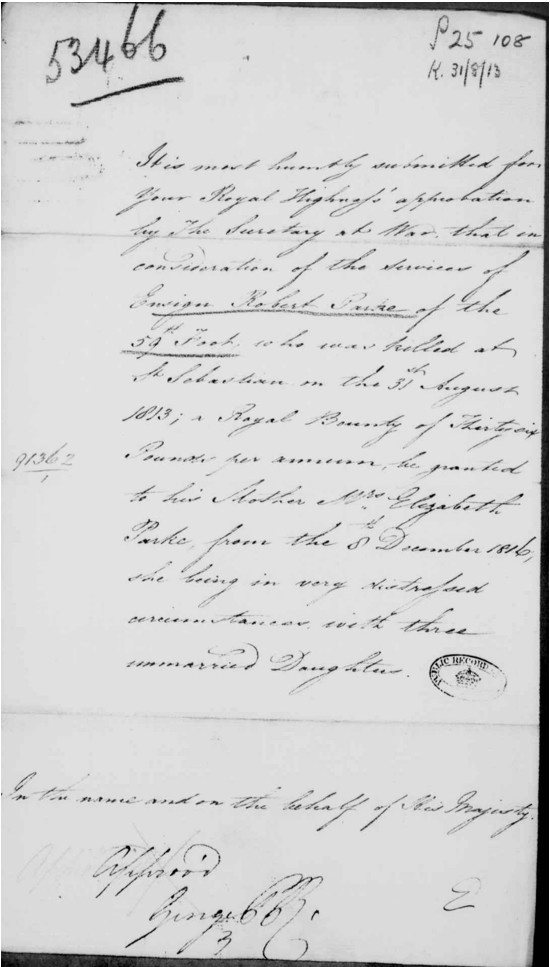
P25 108
-
- 31/8/13
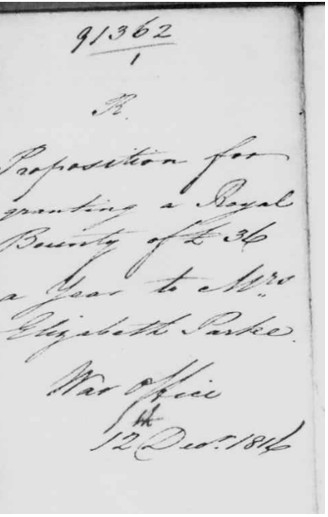
It is most humbly submitted for your Royal Highness’ approbation by the Secretary at War that in consideration of the services of Ensign Robert Parke of the 59th Foot who was killed at St Sebastian on the 31st August 1813; a Royal Bounty of Thirty six Pounds per annum be granted to his Mother Mrs Elizabeth Parke from the 8th December 1816 she being in very distressed circumstances with three unmarried daughters.
In the name and on the behalf of His Majesty
Approved
19th Century
Lieut.-Colonel Sir William Parke
Attended Royal Military Academy, Dublin in 1791, served 2 years in West Indies with 2nd Foot (Captain in 27 Dec 1797). Peninsula War 2nd Foot Aug 1808 – Jan 1809 and Mar 1811 – Mar 1812. Major in 53rd Foot 25 Jul 1810. 66th Regiment of Foot, served in the Rebellion in Ireland 1798, then the Nelson Expedition to Egypt in 1801 where he obtained a medal, then 2 years at the seige of Gibraltar and then the campaign in Portugal and Spain (Peninsular War).
Peninsular War: Wounded at Corunna. Captain 2nd Foot 27 Dec 1797; Major 53rd Foot 25 July 1810; Major 2nd Foot 27 Jun 1811; Major 66th Foot 5 Mar 1812.
Peninsula War 2nd Foot Aug 1808 – Jan 1809 and Mar 1811 – Mar 1812; 66th Foot Apr 1812 – Mar 1813. Vimiero, Coruna, Almaida, Walcheren. Wounded at Coruna.
General Service Medal Vimiero, Coruna, Egypt 1801.
When the 66th Foot was reduced at St. Helena, he was placed on half-pay as Lt.-Colonel and he then returned to Ireland.
Magistrate, High Sherriff of Sligo 1820 and 1838. Deputy-lieutenant of Sligo 1825. Knighted by the Marquis of Normanby when the latter was Lord-Lieutenant of Ireland.
John Parke
Surgeon in the army.
Andrew Parke
Died on service in Spain
Major Charles Parke
abt. 1783 – 3rd November 1858
- 1803 (Commission): He entered the 3rd Regiment of Foot with the rank of Lieutenant.
- 30 January 1806 (Promotion): He achieved his commission to the rank of Captain.
- 1809 (Peninsular War): June 1809 to June 1810, Aug-Nov 1811, Jan-Apr 1814. He deployed with the regiment to the Iberian Peninsula to fight against
- Napoleon’s forces. He was present at the Battle of Talavera (27–28 July 1809). (Army general service medal).
- North America 1814
- 1819 (Brevet Rank): He was advanced to the rank of Brevet-Major.
- 1821 (Retirement): After roughly 18 years of service with the regiment, he retired from the British Army.
Charles has a well-preserved monumental inscription inside Drumcliffe church, erected by his nephew Jemmett Duke, which reads “Sacred to the memory of Major Charles Parke, fourth son of Lieut.-Col. Roger Parke of Dunally Co. of Sligo…”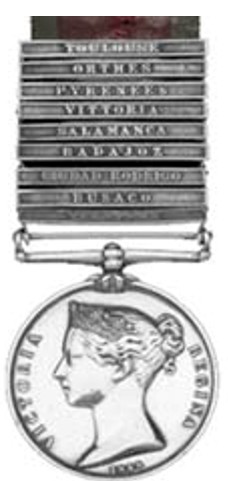
As a member of the British Army, Charles Parke was awarded The Military General Service Medal (MGSM) for military actions from 1793 to 1814; a period covering the FrenchRevolutionaryWars, the Napoleonic Wars, and the Anglo-American War of 1812. Each battle or action covered by the medal was represented by a clasp on the ribbon, with twenty-nine bars been awarded.
Clasps Awarded: Talavera
Service: British Army
Regiment: 3rd Foot
The medal was only awarded to surviving claimants. The Claimant had to survive until 1847 and then actively apply for it.
Major-General Roger Parke
Roger Parke (b. ~1775 – died 1854)
Nephew of Major Andrew Parke and the son of Lt.-Col.Roger Parke of Dunally (who was buried 11 Feb 1819), Roger Parke began his (recorded) active wartime service at the very outbreak of the French Revolutionary Wars.
From: The Royal Military Calendar, or Army Service and Commission Book, Volume 5, edited by John Phillipart, 1820
30 June 1793 Appointed Ensign in 113th Foot (MacDonnell’s Regiment of foot), encamped at Spike Island in Cork Harbour. There was a mutiny and the regiment was disbanded. On 1 October 1793, he was promoted Lieutenant in the 39th (East Middlesex) Regiment of Foot and the regiment was sent to Barbados that year, arriving early in 1794. The Flank Battalion Merge: During this brutal Caribbean campaign, the “Flank Companies” (the elite Grenadier and Light Infantry units) of different regiments—including the 39th Foot and the 33rd Foot—were stripped from their home battalions. They were merged into highly active composite “Light Infantry Battalions” to hunt French forces across the islands. This tactical merger is why his early service records are intertwined with the 33rd Foot’s deployment to Barbados.
1794 – 1795 Fought across the West Indies, surviving the catastrophic yellow fever outbreaks that wiped out entire garrisons. Served under General White at the capture of Demerara, Essequibo, and Berbice, launching directly out of the military hub at Barbados.
9 Oct 1800 Lt. Roger purchased a commission as Captain and remained in Surinam until 1802 when the regiment was ordered back to England, arriving at Portsmouth in April 1803. In the spring of 1805, it arrived in Malta to occupy the kingdom of Naples in co-operation with a Russian and Neapolitan force. This failed, due to the Russians concluding a peace with France. Captain Parke returned to Malta and purchased a commission to Major on 25 February 1808.
25 February 1808 promoted Major by Purchase in 39th Foot, replacing Major Horsburgh.
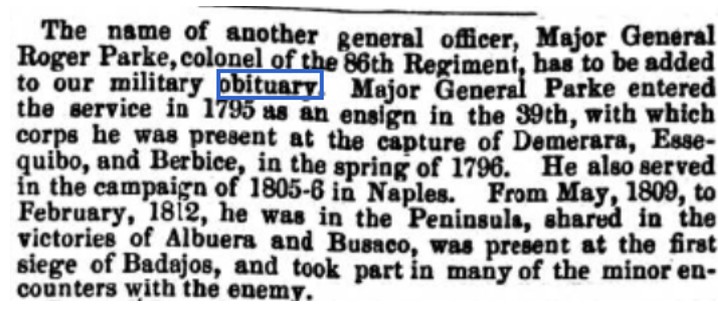
May 1809 Joined 2nd Batallion of the 39th in Guernsey and embarked to the Peninsular War. The 2nd battalion was so reduced by severe service that, on arrival of the 1st battalion, the few remaining men were transferred to the 1st battalion. Major Parke served in the battles of Albuhera, Busaco, Aroya de Molinos (where he was Officer Commanding Brigade of Foot Companies) and was in the trenches in the first siege of Badajos as well as other lesser battles. He was also present at the bloody Battle of Albuhera.
1st March 1812 he arrived at Weymouth with the skeleton of his regiment and was deployed to North America to fight in Canada during the War of 1812 and received the brevet of Lt-Colonel on 4 June 1814 [1]. When the 1st battalion was recalled from Canada to join the Duke of Wellington in Flanders, Parke joined it at Ostend and proceeded to Paris where he remained until the army of occupation was broken up. Achieved rank of Colonel in 1825 and retired on unattached half-pay, eventually being promoted to Major-General on 10 Jan 1837. Major-General of 86th (Royal County Down) Regiment of Foot 1852 – 1854, he held the prestigious ceremonial post as Colonel of the 86th Foot. He died in London and is buried in Kensal Green Cemetery. Both Kensal Green and Brompton hold massive military plots for officers of the Napoleonic Wars.
Hampshire Advertiser Sat. 6 May 1854
Military General Service Medal
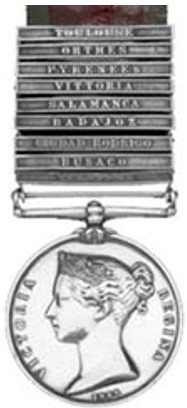
As a member of the British Army, Roger Parke was awarded The Military General Service Medal (MGSM) for military actions from 1793 to 1814; a period covering the French Revolutionary Wars, the Napoleonic Wars, and the Anglo-American War of 1812. Each battle or action covered by the medal was represented by a clasp on the ribbon, with twenty-nine bars been awarded.
The medal was only awarded to surviving claimants. The Claimant had to survive until 1847 and then actively apply for it.
Service: British Army
Regiment: 39th foot
Regiment Alias: Dorsetshire Regiment
Collection: The Military General Service Medal Roll
Lieutenant Roger Parke
Eldest son of Major Andrew Parke. Born about 1788. He was drowned when disembarking a military vessel in Calcutta, on 19 Sep 1805.
Maj. John Charles Bliss Parke
Second son of Major Andrew Parke. Lived 1788 until 1852. Unmarried, he was named after his mother’s family name.
He entered the army as an officer and rose to the rank of Lieutenant in the 1st Battalion, 35th (Dorsetshire) Regiment of Foot. Bliss’s battalion was deployed eastward to secure British interests in the Mediterranean and British India. He spent the tail end of the Napoleonic Wars serving on active garrison duty in the Indian theatre. He eventually rose to the rank of Lieutenant Colonel. He passed away in Bath, Somerset.
The official British Army Lists and the London Gazette track his commissions under his full name, reflecting his service primarily in the 39th (Dorsetshire) Regiment of Foot and later the 53rd (Shropshire) Regiment of Foot. He became Lieutenant on 23 October 1806, Captain on 12 September 1811, Major (Brevet Rank) on 22 July 1830, Major (Regimental Rank) in the 39th Foot on 1 August 1834, and Lieutenant-Colonel 0n 23 November 1841, following which he was placed on the half-pay list. He retired to the prominent Huguenot settlement at Portarlington. He passed away there at the age of 64.
Parke soldiers in the Peninsular war (1808-14)
(source: Captain L S Challis’s “Peninsula Roll Call”):
Charles Parke Captain 3rd Foot 30th Jan 1806. Peninsula June 1809 to June 1810, Aug-Nov 1811, Jan-Apr 1814. Talavera (Army general service medal) and also served North America 1814
Robert Parke Ensign 59th Foot 29 Aug 1812. Peninsula Dec. 1812 – Aug. 1813.Vittoria, Siege of San Sebastian. Killed San Sebastian 31 Aug 1813
Robert Parke Ensign 28th Foot 19 Jul 1810. Peninsula 28 Sep- Nov. 1810 Killed 30 Nov. 1810 at Tarifa. NOW KNOWN TO BE AN ERROR!
Roger Parke Captain 39th Foot 9 Oct 1800; Major 25 Feb 1808; Brevet Lt. Colonel 4 June 1814. Peninsular 39th Foot July 1809 – Jan 1812. Busaco, 1st siege of Badajoz, Albuera, Arroyo dos Molinos, Officer Commanding Brigade of Foot Companies. Service Medal Albuera. Also served West Indies 1795/6 and Naples 1805
Sir William Parke Captain 2nd Foot 27 Dec 1797; Major 53rd Foot 25 July 1810; Major 2nd Foot 27 Jun 1811; Major 66th Foot 5 Mar 1812. Peninsula 2nd Foot Aug 1808 – Jan 1809 and Mar 1811 – Mar 1812; 66th Foot Apr 1812 – Mar 1813. Vimiero, Coruna, Almaida. Wounded Coruna. General Service Medal Vimiero, Coruna, Egypt. Also served West Indies 1795, Irish Rebellion 1798, ?? 1799, Egypt 1801, Walcheren 1809.
As we see in the Peninsula Roll Call, Challis originally listed another Robert Parke as Ensign in the 28 Foot being killed at Tarifa in 1810. This Robert was not able to be placed in either the Sligo or Leitrim branches of the family and the reason became evident after further research:
The official London Gazette and government War Office casualty returns for the Peninsular War do not record any officer named Parke being killed, wounded, or even stationed at Tarifa in November 1810. Captain Challis scoured thousands of messy, handwritten 19th-century War Office records, gazettes, and casualty lists to compile his registry. When Challis logged the records for Robert Parke (28th Foot) and Robert Parke (59th Foot), he ran into a known clerical error: The War Office originally listed an Ensign Robert Parke under the 28th Foot with a notation placing him at Tarifa in late 1810. When historians cross-reference Challis’s individual files with the definitive London Gazette casualty lists, they find that Ensign Robert Parke of the 59th Foot (the Sligo native) survived the 1810–1811 campaigns entirely. His active service record was unblemished until he was tragically killed at the Storming of San Sebastián on 31 August 1813. The officer who actually received that 19 July 1810 commission in the 28th Foot, and was stationed at Tarifa in late 1810, was Ensign Robert Blakeney. Challis’s Peninsula Roll Call remains an incredible resource, but its community-maintained modern updates explicitly flag entries where duplicated names or early War Office clerical errors accidentally merged two different officers’ timelines.
Ensign Robert Parke
Third son of Major Andrew ParkeBorn 1797. Ensign 59th Foot 29 Aug 1812. Peninsula Dec. 1812 – Aug. 1813.Vittoria, Siege of San Sebastian. Killed storming San Sebastian 31 Aug 1813. This was famously one of the bloodiest infantry actions of the entire Peninsular War. While specific personal diaries detailing Ensign Robert Parke’s final seconds do not survive, the broader tactical incident that claimed his life and devastated his regiment, the 59th Foot (2nd Battalion), is heavily documented. [1]
The Disaster at the Breach
The 59th Foot was positioned in the trenches facing a massive gap blown into the stone city curtain wall, known as the Great Breach. At 11:00 AM, the signal was given, and the regiment leaped from the trenches to advance across the open, muddy flats of the Urumea River.
The incident turned into an absolute meatgrinder due to several tactical traps:
-
- The Retrenchment Wall: When the 59th reached the top of the Great Breach, they discovered the French garrison had built a second, hidden loopholed wall directly behind the rubble. The British troops were trapped on a narrow, crumbling ridge of stone, unable to move forward into the town.
- The 12-Foot Drop: To make matters worse, the French had cleared away all the rubble on the inside of the breach, creating a sheer 12-foot drop directly into a burning street packed with French bayonets and barricades.
- The “Murderous Hail”: Trapped on top of the breach, the 59th Foot’s officers and men were completely exposed. French soldiers fired down on them from the flanking town walls, throwing live artillery shells and burning pitch directly into the packed ranks.
The Decimation of the Officers
Ensign Robert Parke was among a massive wave of young officers killed in this exact spot during the opening hour of the assault. Because junior ensigns were traditionally assigned to carry the Regimental Colours (flags) to rally the men, they targeted directly by French sharpshooters.
The catastrophic nature of the incident is reflected in the 59th Foot’s casualty list that afternoon. The regiment lost almost its entire leadership on the breach walls:
-
- Killed outright: Their Acting Major (Captain Francis Scott), Lieutenant William Pery, and five young Ensigns—including Robert Parke, Marcus O’Hara, James Pyne, Charles Vevers, and Lawrence Watson.
- Died of wounds: Two more senior captains died over the following days.
- Wounded: Five additional lieutenants and ensigns were severely mangled by the gunfire. [1]
How the Battle Ended
After nearly two hours of slaughter on the breach, British General Thomas Graham ordered a desperate, high-stakes gamble: he commanded British artillery to fire directly over the heads of the trapped 59th Foot, striking the French defenses just a few feet away. The risky bombardment caused a massive explosion of French gunpowder reserves behind the wall. In the ensuing smoke and chaos, the surviving remnants of the British troops finally scrambled down into the town and captured the city
Major George Thomas Parke
Fourth son of Major Andrew Parke, brother to Lt. Roger, Lt.-Col. John Charles Bliss Parke and Ensign Robert Parke.
2nd Lieutenant Ceylon Rifle Regiment 3 March 1814
Promoted 1st Lieutenant Ceylon Rifle Regiment 12 June 1823
Promoted Captain Ceylon Rifle Regiment 10 August 1826
Brevet-Major Ceylon Rifle Regiment 23 Nov 1841
Deputy Commissioner for Ceylon
Whilst living in Ceylon, George Thomas purchased crown land in the late 1830 and established a large coffee estate (the Dunally coffee plantation) in the Pata Hewaheta/Halaha region near Kandy. He died on 10 February 1852 in Bath and is buried in Lansdown Cemetery, Bath, Somerset, England.
Captain George Fortescue Parke
Son of Major George Thomas Parke and half-brother to Lt. Col. Roger Kennedy Parke. In 1861, he and a companion (Captain Matthew Ford) were drowned when the yacht in which they were sailing capsized on lake Windermere. Buried in Lansdown Cemetery, Bath.
Lt.-Colonel Roger Kennedy Parke
Son of Major George Thomas Parke and half-brother to Captain George Fortescue Parke. He was commissioned Coronet, by purchase, into the 3rd Regiment of Dragoon Guards on 10 August 1870, achieving the rank of Major in 1888 and later achieving the rank of Lieutenant-Colonel. During the Boer War, he commanded the 18th Battalion of the Imperial Yeomanry and was awarded the Companion of the Order of the Bath (C.B.). Following his retirement from the military, he served as High Sheriff of Sligo in 1910, before his death on 11 January 1911.
Captain William Henry Parke
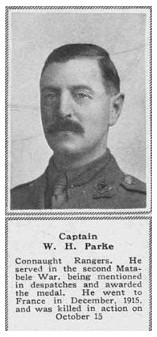
Eclipsed in fame by his older brother (Thomas Heazle Parke) he was a son of William Parke, J.P. and Henrietta Artta Holmes, born 21 April 1870 in Drumsna, County Leitrim, Ireland. (6th. Bn.Connaught Rangers) Second Lieut. 5th Bn Connaught Rangers 29th April 1889; Lieut. 2nd August 1890; Captain 3rd. March 1897. Served Matebele War, Medal; resigned 22nd February 1899; reappointed Captain 25th November 1914; Acting Major whilst 2nd in command of 6th Bn Connaught Rangers after The Battle of Guillemont 3rd Sep 1916. Killed in action by artillery fire at S.P. 13, Siege Farm, Kemmel on 15th October 1916. Married Margaret J. Houstoun about November 1915 at Hambleton, Surrey.
Surgeon Major Thomas Heazle Parke
One of 10 children to parents William Parke JP and his wife Henrietta Artta Holmes, Thomas Heazle was born 27 November 1857 at Clogher House in Kilmore, County Roscommon and brought up in Carrick-on-Shannon, County Leitrim. In 1878, he graduated from the Royal College of Surgeons in Ireland. Registering as a medical practitioner in 1879, he worked as dispensary medical officer in Ballybay and then as a surgeon in Bath, England.
In 1881, he was appointed to the British Army Medical Department. In 1882-85 he served as a military surgeon in Egypt (the Nile Expedition) and was in the Sudan campaigns to relieve General Gordon at Khartoum.
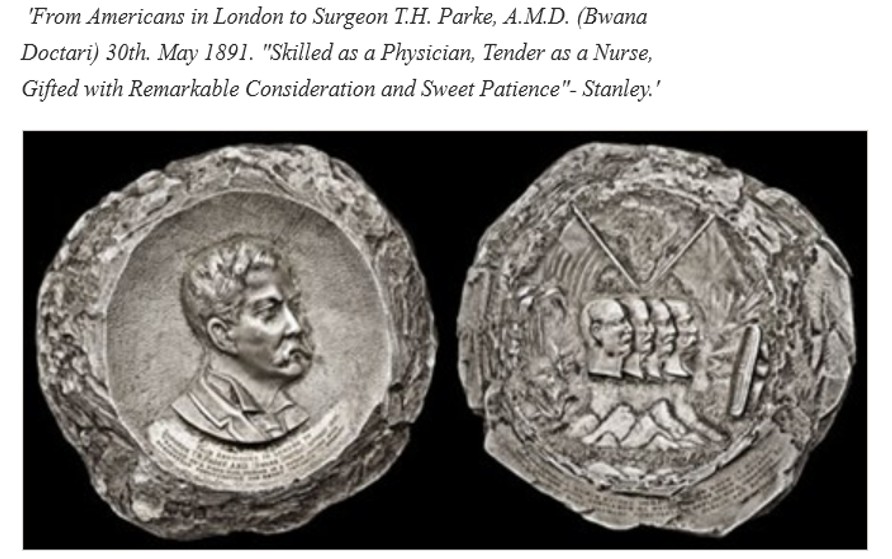
He served alongside Stanley in the Advance Column as Medical Officer on the Emin Pasha Relief Expedition of 1887-89, led by Sir Henry Morton Stanley, on which he saved the lives of both Stanley and Emin Pasha, while in the process becoming the first Irishman to cross the African Continent. He figures prominently in Stanley’s two-volume book In Darkest Africa and published his own book My Experiences in Equatorial Africa.
Some photographs of Thomas Heazle Parke
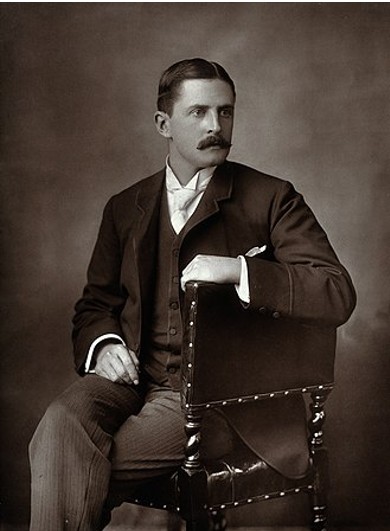
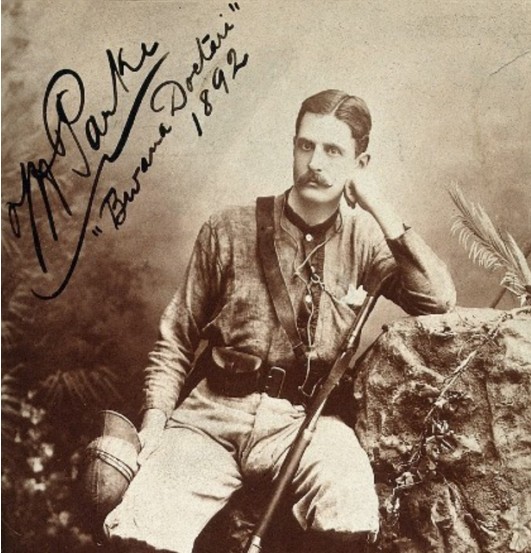
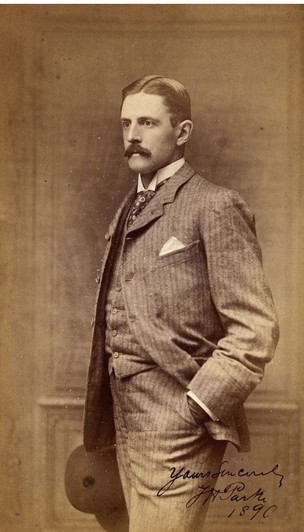
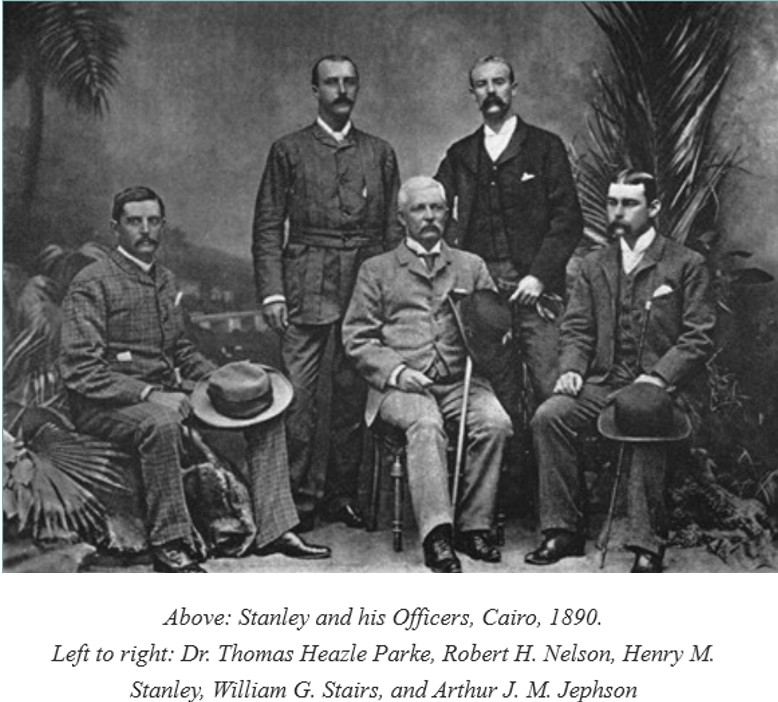
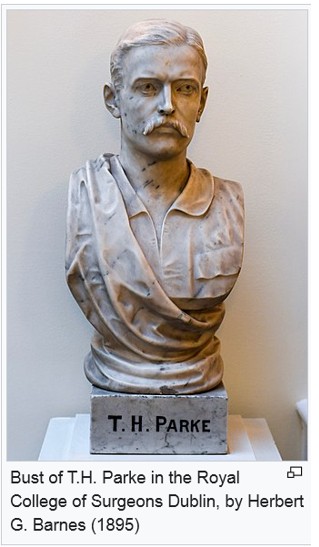
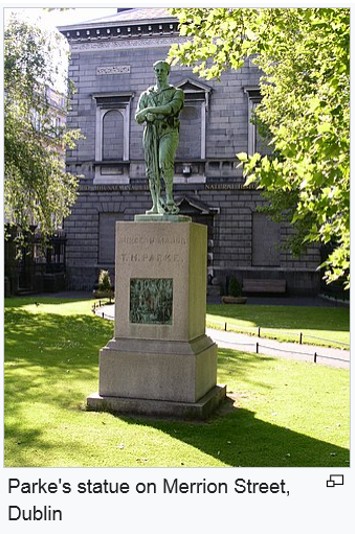
After his return from Africa, he resumed work as a surgeon, being promoted to surgeon-major in 1893. Parke’s general health was good, but he had developed a liability to convulsive attacks, possibly an indication of cerebral cysticercosis. In August 1893 he visited his friends the duke and duchess of St Albans, whose yacht lay off Ardrishaig, Scotland, and on the morning of 11 August 1893 was found dead in his bedroom, still fully dressed – presumably he died in the course of a seizure. His remains were taken to Ireland for burial at Drumsna, Co. Roscommon, near Clogher House. His funeral was accorded military honours as it passed through Dublin. His statue (1896) by Percy Wood stands outside the Natural History Museum, Merrion St., Dublin.
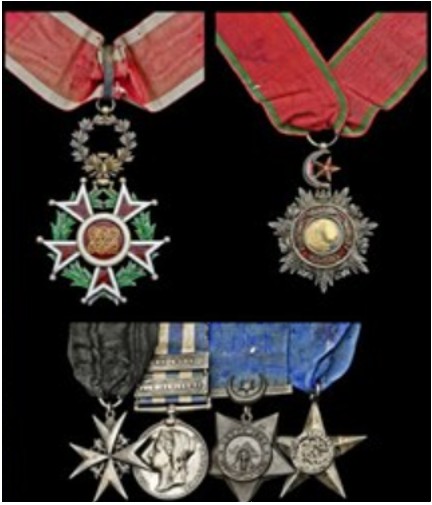
On 21st November 2013, Spink auctioneers in London offered for auction a group of honours and awards bestowed upon Thomas Heazle.